All posts by Kevin

Baby Name Wizard

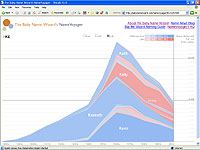
A screen shot of the Baby Name Wizard displaying names beginning KE
Baby Name Wizard

The Baby Name Wizard’s
NameVoyager is interesting. It displays a dynamic frequency distribution for the most popular (top 1,000) first names for American children born since 1880.

Having run some of my relatives’ names through it I can see that my extended family has been pretty conventional in its choice of names over the years, despite not residing in the US.

Let it stand

Excerpts from Stet by Diana Athill, who was apparently considered the best editor in London during the second half of the twentieth century.

Writing about the first book she was responsible for publishing at André Deutshe:

I would soon begin to find such fantasies a waste of time — of my time, anyway — but then, in addition to liking the sobriety and precision of the style, I felt the pull of mystification: ‘I can’t understand this — probably, being beyond me, it is very special.’ This common response to not seeing the point of something has a rather touching humility, but that doesn’t save it — or so I now believe — from being a betrayal of intelligence which has allowed a good deal of junk to masquerade as art. Whether that matters much is another question: throughout my publishing life I thought it did, so I am glad to say that the publication of The Tailor’s Cake in 1946, beautifully translated by Betty Askwith, was the only occasion on which I succumbed to the charm of mystification.

On her love of books:

I loved that book [The Toe-Rags by Daphne Anderson] even more than I loved Morris Stock’s [Parents Unknown: A Ukrainian Childhood]; and both of them I loved not for being well-written (though both were written well enough for their purposes), but because of what those two people were like. They brought home to me the central reason why books have meant so much to me. It is not because of my pleasure in the art of writing, though that has been very great. It is because they have taken me so far beyond the narrow limits of my own experience and have so greatly enlarged my sense of the complexity of life: of its consuming darkness, and also — thank God — of the light which continues to struggle through.

Much to my surprise Diana Athill writes a lot about Caribbean literature in Stet. Not only are there long chapters on Jean Rhys and V. S. Naipaul, but Athill was also Eric Williams’ editor and travelled to both Dominica and Trinidad & Tobago in the course of her career. In addition, she had an affair with Hakim Jamal, an American disciple of Malcolm X, who was involved in the murders in 1972 that formed the subject of Naipaul’s story The Killings in Trinidad. I found it all quite unexpectedly fascinating and would recommend it, not least because it’s exceptionally well-written.

Catching up

Well, what happened here? I haven’t posted anything in over a month. No excuses, really — although the Movabletype publishing system did stop working on my server for a while (no idea why, but it was my hosting company’s fault). I was just busy and uninspired.

Anyway, here’s what’s new.

A photograph of blossom on a tree.
Spring has sprung!
  • Lest that previous photo confuses you, be aware that it’s now spring in the UK.
  • We’re also in the middle of an election campaign. If you’re interested in the story so far, the two best articles that I’ve read on the subject are What is Labour for? by John Lanchester published in the London Review of Books (actually a book review) and Britain’s battlelines redrawn by fear by Philip Stephens in the Financial Times.
  • The election takes place on May 5, which is also when a friend of mine will make her Wigmore Hall debut. Carol Isaac and I used to work together at Roy Thomson Hall in Toronto, and she’ll be accompanying American soprano, Twyla Robinson, in a recital of songs by Janácek, Brahms, Berg and Dvorák. I may be mistaken, but I don’t think either of them has performed at Wigmore Hall before.
  • I’m experimenting with a new family history web site. It may not be a permanent fixture, so explore at your own risk. The main advantage is that the database is online, so the pages always display the latest information. In other words, I don’t have to update the site manually!
  • People who embrace a technology early on in its development are known as “early adopters”, but it’s increasingly evident that the term can be applied to organisations as well. This is certainly the case with RSS (Rich Site Syndication or Really Simple Syndication), a technology that allows information to be easily syndicated across the web. It was incorporated into weblogs, so that people could stay up to date with a weblog’s content without having to visit the weblog’s home page, and it has improved accessibility to such an extent that you can digest much, much more information than normal using a RSS “newsreader“. After the blogging community adopted RSS, progressive news organisations such as the International Herald Tribune and Christian Science Monitor started to implement it. Last month the Financial Times and the Economist, both industrial Luddites in their own ways, finally jumped on the bandwagon. So it’s now clear that RSS has arrived.
  • And last, but not least Canada is apparently in an e-Government league of its own.

Proof

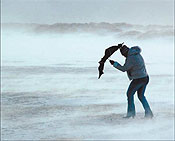
A photograph of a woman struggling against the wind and snow with her umbrella in tatters.
Umbrellas are useless in the snow

A photograph very similar to the one at right appeared on the cover of one of Britain’s national newspapers today, and perfectly illustrates a point I’ve made before: namely that umbrellas are a useless defence against snow.

Almost half of the British Isles is further north than Moscow, yet many of the British still have no idea how to cope with winter weather.

The antidote

From the Daily Telegraph:

Directors at Jessops are contractually bound to receive as little as a week’s payoff if they are fired after a big fall in the company’s share price, according to the camera equipment retailer’s annual report.

The clause, which was agreed by Jessops’ two executive directors when the company floated in November, has been hailed as an “innovative approach” by corporate governance campaigners to tackle the issue of directors being rewarded for failure.

Priceless

From the Financial Times:

Carly Fiorina will be paid a $21.4m severance package after being fired as chief executive of Hewlett-Packard last week. She will also be able to keep her computer and receive free tech support for three months.

Only three months? It’s a good thing she got the cash.